Article 1 · Link trust · 6 min read
How to check whether a Fishgoo Spreadsheet link is still useful
Spreadsheet rows go stale fast. The cleanest first test is opening the link in a private window: a Weidian or 1688 listing that has been delisted will return a generic homepage rather than the product page, and a Yupoo album that has expired will prompt for a password instead of showing the catalogue. From there, three checks decide the rest. First, scroll to the seller's most recent upload date — anything older than 60 days is usually a dormant store, while a buyer photo posted in the last fortnight is the strongest possible confirmation that the listing is still being fulfilled. Second, look for a batch tag in the spreadsheet column or the product title; the same item ID can swap batches over the course of a year, so a "v2 batch" tag from six months ago is no guarantee the warehouse is shipping that same batch today. Third, copy the seller alias into the platform's search bar — many sellers migrate listings to a new SKU after a trademark complaint, and the new listing will surface under their store search even when the spreadsheet row is dead. When in doubt, paste the link into Fishgoo and let support try a reverse-image lookup; they can usually locate a moved listing if you give them the original product name plus the spreadsheet's hero photo.
Article 2 · Marketplaces · 7 min read
Taobao vs Weidian vs 1688 vs Yupoo — what each source is actually good for
The four marketplaces behind every Fishgoo spreadsheet do different jobs, and treating them as interchangeable wastes time. Taobao is the largest and most consumer-friendly — listings include reviews, sales counts, and multi-SKU charts, and the platform itself enforces some seller accountability. It is the safest source when the buyer wants reassurance from peer reviews, but it is also where reseller listings sometimes mask the underlying factory. Weidian is where most reps and small factories actually sell; listings are sparse, communication is closer to direct messaging than retail, and the same store regularly swaps batches under the same item ID, so the batch tag matters more than the SKU number. 1688 is the wholesale tier — factory listings with minimum order quantities, lower prices, and rougher photos; it is best when you want the original factory behind a Taobao reseller, and Fishgoo support can usually negotiate single-unit orders despite the listed MOQ. Yupoo is not a marketplace at all but a photo-album platform that sellers use to showcase inventory without a checkout, so a Yupoo link in a spreadsheet means the photos are real but the actual order has to be placed through WeChat or Weidian — which Fishgoo handles on your behalf if you give them the album link plus a clear note on size, colour, and quantity.
Article 3 · QC photos · 8 min read
How to read QC photos before you approve a warehouse item
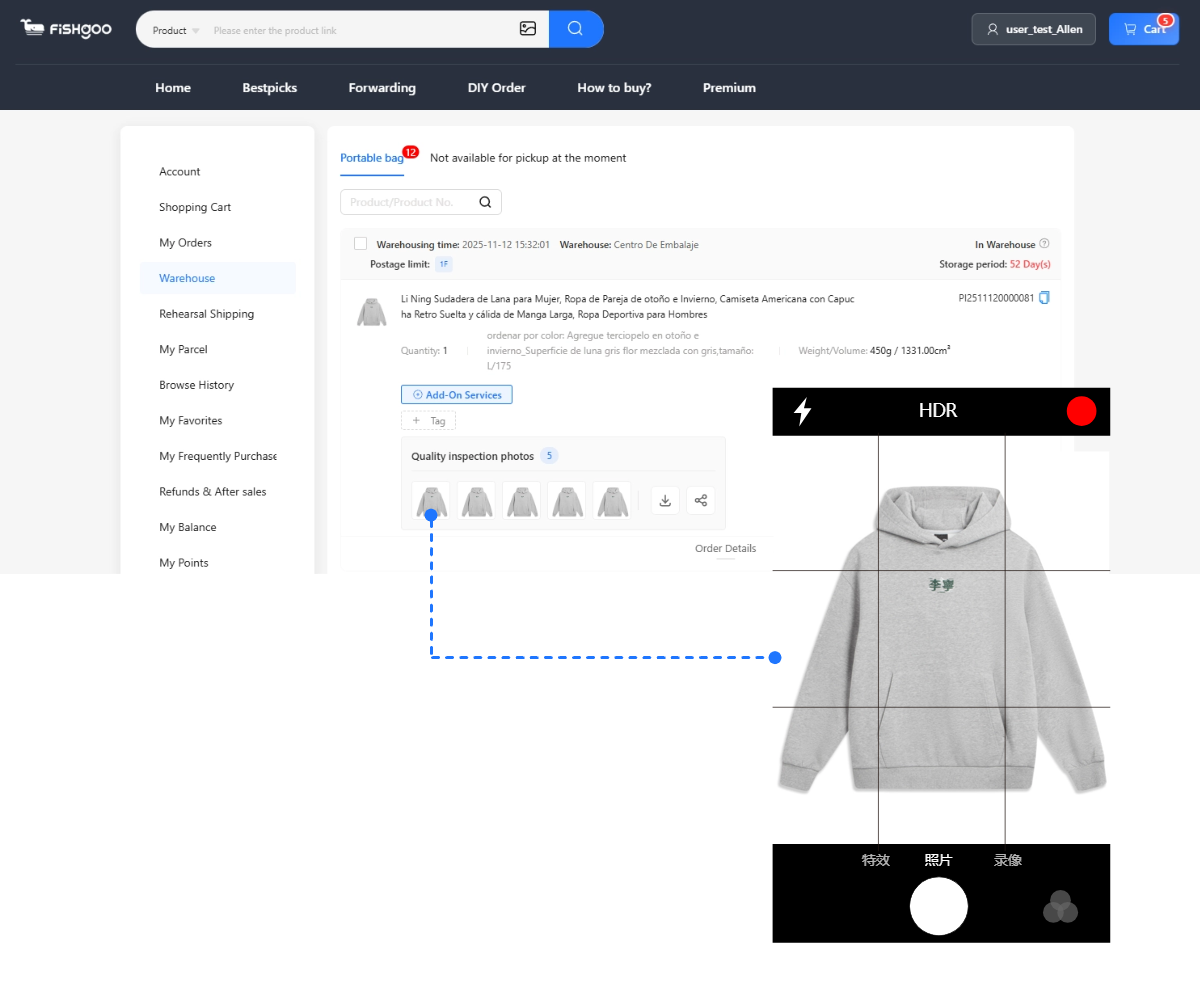
Quality control on a buying-agent workflow is not a vibe check. Every category has two or three photos that catch most of the surprises, and approving without seeing them is how exchange windows close before the issue is even noticed. For sneakers, ask for the insole length photographed on a ruler with the heel cup pressed flat — that single image catches the majority of size disputes, and a tongue-and-toe-shape close-up handles batch verification. For jackets and hoodies, the zipper tape stamp, the lining stitching, and an estimated shell weight in grams together tell you whether you are receiving the "winter" batch or the "spring" one the seller might quietly substitute. For tees, the alignment of the print to the centre and shoulder seams, the gsm of the blank, and the neck tag photo cover the obvious risks. For jerseys, the badge alignment, the heat-press edge of the name set, and the sleeve patch close-up matter more than the front photo. The decision is straightforward once the right photos are in front of you: approve when everything matches the album hero and the listed specs, ask for one or two extra photos when something is unclear, and exchange or return when the QC contradicts the listing. Most sellers honour exchanges within seven days of warehouse arrival, so the QC decision should not sit on the dashboard for long.
Article 4 · Shipping · 7 min read
Why shipping costs more than the item price sometimes
The single concept that decides whether a haul ships at the price you expected is volumetric weight. Carriers charge whichever is greater — the scale reading or the dimensional weight, calculated as length × width × height ÷ 5000 for most air freight. A pair of high-top sneakers might scale at 1.6 kg but occupy 13,000 cm³, which gives a 2.6 kg dimensional weight, and the carrier bills the higher number. Jackets and bags are the volumetric champions: a folded mid-weight shell averages 0.8-1.2 kg in real weight but routinely doubles that in dimensional weight after foam-bag packing. The other multiplier is sensitive-item routing — lithium batteries, magnets, branded replicas, and certain liquids force the parcel onto a surcharged line that can be 30-60% more than the standard quote. A real-haul example: a $40 hoodie, a $25 pair of sneakers, and a $15 cap might total $80 in product, but after volumetric weight and a single sensitive-item surcharge the parcel can land around $70-$90 on its own. The two habits that prevent surprises are rehearsal packing (ask Fishgoo to weigh and measure before charging shipping) and checking each item against the line's restriction list before paying.
Article 5 · First haul · 6 min read
How to build a first haul without making every beginner mistake at once
First hauls fail in predictable ways. The biggest single mistake is volume: ordering ten to fifteen items before understanding how shipping weight scales, then watching the parcel quote exceed the entire product total. Start with two or three items, finish the workflow end to end, then scale on the second order. The second mistake is timing the QC — approving photos quickly to "save time" feels efficient, but the seven-day exchange window starts at warehouse arrival, and rushing past a fuzzy QC photo means the wrong-size hoodie or off-batch sneaker is yours by the time the parcel ships. The third mistake is trusting old spreadsheet rows without verifying the seller's most recent buyer photo — see the link-trust article above. The fourth is picking the cheapest shipping line before checking restrictions; a "cheap line" that refuses your battery or magnet item costs you a re-pack and a delay. The fifth is forgetting to screenshot — every QC photo, every seller chat handoff, every shipping quote. When something goes sideways, the screenshots are the evidence that resolves the support ticket. Take those five mistakes off the table and a first haul becomes uneventful, which is exactly what you want.
Read next
Open a category page to apply the article checklists
Each article above maps to a category-specific guide where the QC, sizing, and shipping checklists live in detail.